Pietro, Bruno, and His Father Make Their First Glacier Excursion
The Eight Mountains: A NovelPietro, Bruno, and His Father Make Their First Glacier Excursion is the boys’ first journey onto a glacier with Pietro’s father, and the last occasion Pietro remembers the three of them together on the mountain. A planned excursion becomes a test of Pietro’s physical limits and his father’s judgment; its meaning endures less as an ascent than as a brief, precarious bond among three people tied to the same rope.
The Approach and the Refuge
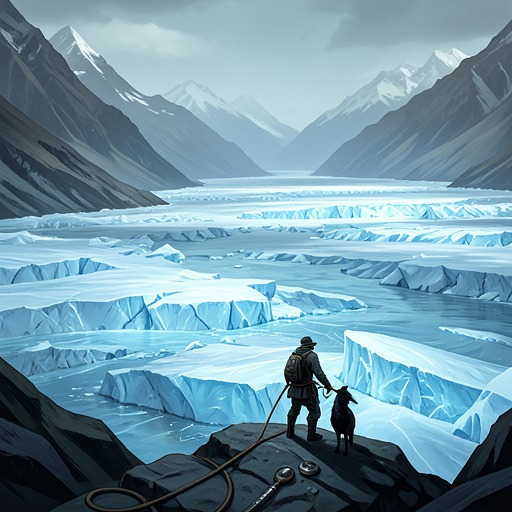
Before the climb, Pietro’s father had explained the glacier as a store of past winters: snowfall preserved above the level of permanent snow cover accumulates into layers of ice, while the glacier itself continues to move downhill. The idea fascinated Bruno, who watched the crevasses, but Pietro’s attention was fixed more on how far the group was going. They were approaching ground beyond the point where earlier outings had turned back, and the weather was unsettled: rain had fallen, evening was coming on, and fog lay ahead.
At the end of the moraine, the three found a two-storey wooden refuge. That evening it was full, with some climbers sleeping on benches or tables. Pietro and Bruno, the youngest there, ate early and went upstairs to share a bed so that others could use the dining area. They listened from the dormitory as the climbers below compared routes, weather, and past refuge nights. Pietro’s father ordered a liter of wine and joined them, trading jokes in Veneto dialect with people from his own region. He had become known among the climbers for bringing two boys up a glacier, and the role pleased him. Pietro, shy and embarrassed, heard a side of his father that felt unfamiliar.
Across the Glacier and Back
The party left before daybreak, after the fog had filled the valleys and the sky had cleared to a pale, pearly color. Pietro’s father attached the hired crampons and roped the three together, with himself first, Bruno in the middle, and Pietro last, five metres between each person. The preparation was slow: his father had not tied such knots for years, and the crampons knocked against the scree. Once Pietro stepped onto snow, however, the metal points gripped firmly and his legs felt unexpectedly strong.
That strength did not last. As the warmth of the refuge wore off, nausea grew, and Pietro struggled to keep pace. His father pressed onward, apparently in a hurry; Pietro suspected that, despite describing the trip as short, he hoped to reach a peak. The sun rose, the snow became glaringly bright and began to soften beneath their crampons, and clouds swelled below them. Still, his father did not readily turn back. When they reached a crevasse, he judged its width, crossed, anchored the ice axe, and brought Bruno across. Pietro, waiting his turn, looked back toward the refuge, now disappearing into fog, and felt that the group might not get back. At the edge of the crevasse, with Bruno already across, Pietro vomited onto the snow. His altitude sickness was no longer hidden.
His father’s response surprised him. Instead of anger, Pietro saw alarm: his father crossed back, tangling the rope in the process, and immediately began the descent. He knew that the remedy for altitude sickness was to lose altitude. Reversing the rope order so Pietro could walk first, he let the boy stop whenever he felt ill. Pietro remained weak and retched, but Bruno gave him snow packed into ice to suck, and the descent eased his stomach. In the fog, Bruno used the rhythmic call with which he brought cows to the stable, helping Pietro keep walking when he could barely stay upright. The return depended on practical care: his father changed the route and rope order, while Bruno lent the familiar rhythm of his work.
A Brief Bond, and Its Limits
Pietro later remembered the outing as a morning in August 1984 and the final memory he had of that summer. The next day Bruno would return to the high pastures, and Pietro’s father would go back to Milan. On the glacier, for that short interval, the rope joined all three of them whether they wished it or not. The physical connection sharpened the contrast between Pietro’s sense of vulnerability and the closeness he saw ahead of him: after Bruno crossed the crevasse, Pietro watched his father slap him on the back in congratulations. In that moment, the two looked to Pietro like a triumphant father and son. The image stayed with him, and he said nothing when Bruno later asked about the depth of the crevasse.
The excursion also complicates Pietro’s view of his father. He had expected irritation when he faltered, yet his father’s fear revealed how much danger the climb involved: Pietro was eleven, poorly equipped, and on a glacier under worsening weather, being led upward by his father’s persistence. The father who pushed ahead was also the one who turned around at once when his son became ill. Neither aspect cancels the other. The episode records both the risk of his determination and the care with which he responded once the danger became undeniable.
The Excursion in Later Memory
Years afterward, Pietro found his father’s mountain map still pinned to the wall. Its dense network of trails had become a record of his father’s life in the mountains. Reading its colors, Pietro recognized that the red and green routes ended at the point where the three had stopped on the glacier, while the black route continued. He understood that his father had gone farther alone on another occasion; the map preserved the limit of that shared trip alongside the separate journeys that followed. Its lines turned a childhood outing into part of a larger family record, one Pietro could only read after his father was gone.
Pietro also came to understand the glacier itself through his father’s account of it as a memory of winter. His father had not liked retracing unhappy ground, yet glaciers could bring something back to him. Much later, Pietro recognized the mountain-going father as distinct from the urban stranger with whom he had lived for years. The glacier excursion had offered only a glimpse of that other father, not a complete reconciliation. But its remembered rope, the fog, and the retreat gave Pietro a concrete point from which to understand the man he had only partly known.